Fao Yearbook 2017 Beef and Veal Production
Livestock population
Majority of livestock populations concentrated in only a few countries
The EU has a sizeable livestock population: in 2020, there were 146 meg pigs, 76 million bovine animals and 75 million of sheep and goats.
A bulk of the EU's livestock is held in but a few of the Member States (see Figure 1).
Betwixt 1 fifth and one quarter (23.iii %) of the EU'south bovine population was found in French republic and similar shares of the Eu's pig (22.4 %) and sheep (24.8 %) populations were in Spain. Greece (28.8 %) and Spain (21.iv %) together deemed for more than than half of all the Eu's goats.
Some of the EU Member States are relatively specialised in terms of livestock farming. For example, Ireland accounted for viii.v % of the European union's bovine animals in 2020 (almost the same level every bit recorded in Spain), while Denmark accounted for 9.2 % of the Eu'due south sus scrofa population (almost the same level as in France). Afterwards Espana, the second and third largest sheep populations in the European union were in Romania and Greece, with 16.8 % and thirteen.2 % shares respectively.

Downward trend in livestock populations
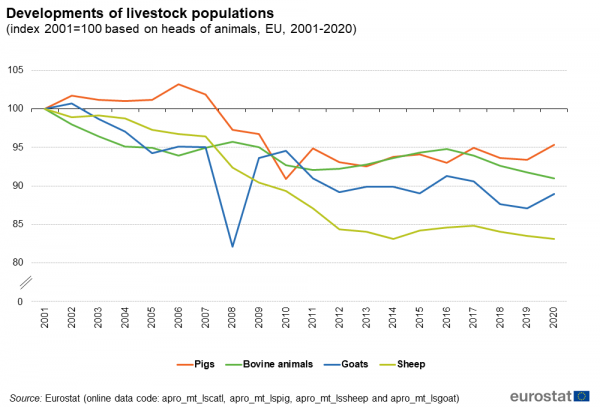
During the last two decades, there has been a decline in livestock populations across the EU (run into Effigy two). Between 2001 and 2020, the Eu's full livestock count for pigs, bovine animals, sheep and goats savage by an estimated 8.nine %. The number of head declined for each livestock population during the period nether consideration: the largest overall turn down (in pct terms) was recorded for the number of sheep, while the reduction in pig numbers was relatively modest.
Looking in more detail at developments between 2019 and 2020, the population of pigs in the Eu increased by ii.ii %. There was most no change (down 0.1 %) in the number of head of sheep in 2020, while there was a 0.9 % fall in the number of bovine animals.
During the period 2015-2020, EU output price developments were relatively stable for most animals, with the price of pigs being the primary exception (come across Figure 3). Having risen at a rapid stride between 2016 and 2017, output prices for pigs and then fell dorsum in 2018 before rebounding in 2019 and falling again sharply in 2020. Throughout the period from 2016-2019, output prices for sheep and goats remained below their average level for 2015, but so grew at a rapid stride in 2020 (up a provisional vii.viii % as a year-on-year average). Having fallen relatively sharply in 2016, output prices for poultry remained relatively stable in 2017, 2018 and through to the second quarter of 2019 earlier falling again; in 2020 the average price over the year was 2.9 % less than the boilerplate in 2019. The output toll of cattle was relatively unchanged, although toll developments followed a downward path in both 2019 and 2020.
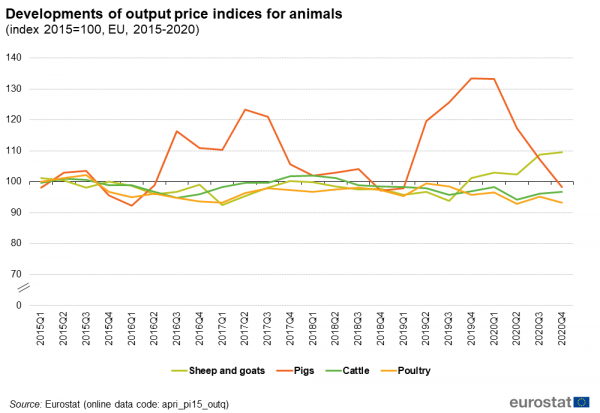
Figure iii: Developments of output cost indices for animals
(alphabetize 2015=100, EU, 2015-2020)
Source: Eurostat (apri_pi15_outq)
Meat product
Better animal welfare improves animal health and food quality. Within the context of the European union'southward Subcontract to Fork Strategy, the European Commission plans to revise legislation concerning the slaughter of animals and so that it is aligned with scientific evidence, broadening its scope, making it easier to enforce, and ultimately ensuring a college level of animal protection/welfare.
Data is collected on the number and weight of carcasses at slaughterhouses, whose meat is deemed fit for human being consumption. In this commodity, 'meat' should be understood as the carcass weight from slaughterhouses.
Pigmeat
Pigmeat production reached a new peak in 2020
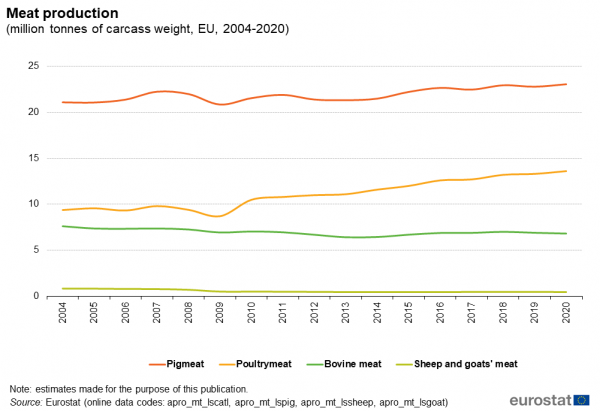
The EU produced a provisional 23.0 million tonnes of pigmeat in 2020, a moderate rising on 2019 (+1.2 %) to a new tiptop (encounter Effigy 4). To put this in context, production in 2020 was one.9 million tonnes more in 2004.
The two main pigmeat producing Fellow member States are Germany (v.1 one thousand thousand tonnes in 2020) and Spain (5.0 million tonnes). Whereas production in Germany further declined in 2020 (downward -2.two %), a fourth successive annual wrinkle, information technology rose sharply in one case once more in Spain (+vii.eight %, a seventh successive year of growth). In that location was also some other twelvemonth of growth in the netherlands (+2.0 %).
Poultrymeat
Poultrymeat production in EU at loftier in 2020
The European union produced an estimated thirteen.6 meg tonnes of poultrymeat in 2020, a new loftier. Confronting the backdrop of an upwardly tendency, this represented a further two.3 % ascension in production compared with 2019. It pushed EU product some iv.2 million tonnes higher up the level recorded in 2004, a cumulative ascent of about 45 %.
In 2020, the principal poultrymeat producers in the Eu include Poland (xix.8 %, with 2.7 million tonnes), Spain (12.6 %, with 1.7 million tonnes), France (12.3 %, with one.seven one thousand thousand tonnes), Germany (11.9 %, with 1.six one thousand thousand tonnes) and Italy (10.2 %, with ane.iv million tonnes). Among these fundamental producers, product levels rose in Poland (+4.0 %), Germany (+ane.8 %) and Italy (+1.seven %), stabilised in Spain (+0.2 %) just declined in French republic (-1.3 %).
Veal and beefiness
Beef is the meat from the slaughter of bovine animals of at least one year old. Certain cattle breeds are reared specifically for their beef, although beef can also come from dairy cattle. In this article veal is considered every bit the meat from bovine animals younger than one year (usually male calves and young cattle). Male calves from dairy cows are of no use for producing milk and their growth potential for producing beefiness meat is not optimal.
Farther dip in production of bovine meat in 2020
The EU produced a provisional 6.8 million tonnes of bovine meat (beef and veal carcasses) in 2020, which was slightly less (-i.2 %) than in 2019. This reject should exist seen in the context of steady rises that came later on the end of milk quotas on 31 March 2015, as it has led directly to increased cow slaughter, with some of the smallest farms abandoning dairy production. Before then, there had been a downwards trend in bovine meat product through to 2013, which now appears to have restarted (see Effigy 4).
One-half of the EU's beefiness (see Figure 5) was produced in 3 Member States: French republic (21.two %), Germany (17.8 %) and Italy (xi.i %).
About 70 % of the European union's veal meat was also produced in three Member States: the netherlands (26.5%), Spain (24.0 %), and France (20.1 %).
Sheep and goats' meat
Unchanged sheep and goats' meat production
The European union produced an estimated 0.v million tonnes of sheep and goats' meat in 2020, which was iii.9 % less than in 2019. Sheepmeat accounted for the vast majority (about ninety %) of the combined total output.
3 quarters of the European union'south sheepmeat was produced in Espana (27.4 % in 2020), France (xix.1 %), Ireland (xv.8 %) and Greece (xi.7 %). The principal producers of goatmeat among the EU Member States are Greece and Spain.
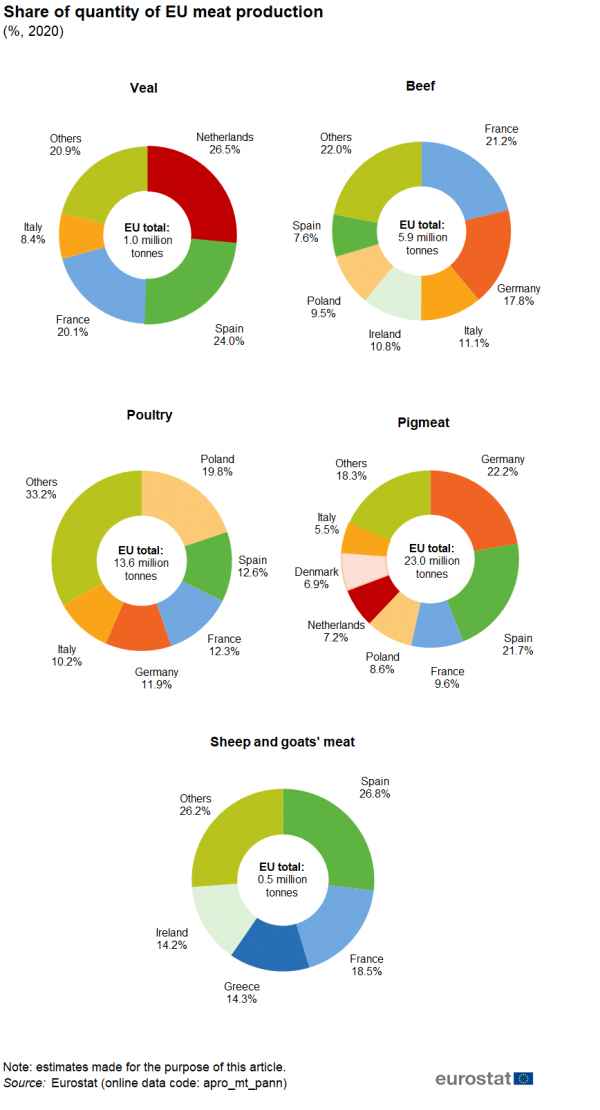
Figure 5: Share of quantity of EU meat product
(%, 2020)
Source: Eurostat (apro_mt_pann)
Source data for tables and graphs
-
 Livestock and meat: figures
Data sources
Livestock and meat statistics
Livestock and meat statistics are collected by EU Member States under Regulation (EC) No 1165/2008, which covers bovine, hog, sheep and goat livestock; slaughtering statistics on bovine animals, pigs, sheep, goats and poultry; and production forecasts for beefiness, veal, pigmeat, sheepmeat and goatmeat. Livestock surveys embrace sufficient agricultural holdings to account for at to the lowest degree 95 % of the national livestock population, as determined by the last survey on the structure of agronomical holdings.
Bovine and pig livestock statistics are produced twice a year, with reference to a given mean solar day in May/June and a given day in November/December. Those EU Member States whose bovine animal populations are beneath 1.5 million head or whose sus scrofa populations are below 3.0 1000000 head may produce these statistics just in one case a year, with reference to a given day in November/December. The November/Dec results are available for all Eu Member States and are used in this commodity.
Sheep livestock statistics are only produced one time a year, with reference to a given solar day in Nov/December, by those European union Member States whose sheep populations are 500 000 head or to a higher place; the same criteria and thresholds utilise for statistics on goat populations.
Agronomical price statistics
EU agronomical price statistics (APS) are based on voluntary agreements between Eurostat and the EU Member States.
National statistical institutes or Ministries of Agriculture are responsible for collecting absolute prices and calculating corresponding average prices for their country, as well as for calculating price indices and periodically updating the weights.
Price indices are reported quarterly and annually. Absolute prices are reported annually. The agronomical prices expressed in national currency are converted into euro by Eurostat using the fixed exchange rates or fiscal market exchange rates, in order to allow comparisons betwixt the Eu Member States. Eurostat is responsible for calculating indices for the European union.
Context
Statistics on livestock and meat product (based on the slaughter of animals fit for homo consumption) requite some indication of supply-side developments and adjustments, which are important for monitoring the common agricultural policy (CAP).
One of the objectives of the first CAP was to secure the availability of food supplies for the people of the then European Economic Community. The CAP has evolved, requiring more agricultural market transparency for all actors and Eu citizens. Statistics for livestock and meat, as with other agricultural products, help provide feedback on marketplace signals.
In order to limit uncertainty, European union institutions in charge of marketplace support interpret the market signals using livestock numbers for their forecasts. The number of breeders (for dairy or meat production) also every bit animal stocks being grown and fattened, contribute to preparing measures that ensure a more stable — or at to the lowest degree more secure — market, which aims to benefit both EU consumers and farmers.
The European union has introduced a range of legislation covering the traceability of livestock, in office as a response to various nutrient rubber concerns. For most creature species, this traceability concerns a system of identification — usually through ear-tags or tattoos — coupled with a national register that details animals as they are reared, held or handled at each phase of the food chain. The European Committee has been active in harmonising animal health measures and systems of disease surveillance, diagnosis and control; it has as well adult a legal framework for trade in alive animals and animate being products. Ensuring the high quality of food is 1 of the diverse challenges to be met in order to secure this food supply.
Every bit part of the Eu'south Farm to Fork Strategy, the European Commission is in the process of drafting a proposal to revise the Feed Additives Regulation ((EC) No 1831/2003) with the goal of reducing the environmental impact of livestock farming. For example it volition examine rules to lessen dependency on feed materials grown on deforested land, and aim to supercede these with EU-grown plant proteins and alternative feed.
orozcothismillond.blogspot.com
Source: https://ec.europa.eu/eurostat/statistics-explained/index.php?title=Agricultural_production_-_livestock_and_meat&oldid=427096
0 Response to "Fao Yearbook 2017 Beef and Veal Production"
Post a Comment